“Future Ready.”
Those two words represent the FISD Career and Technical Education (CTE) Center’s mission to prepare its students for professional careers, ranging over 25 pathways. With the rise of artificial intelligence, however, the center’s classrooms are finding ways to incorporate the ‘future ready’ philosophy with AI’s industry impacts.
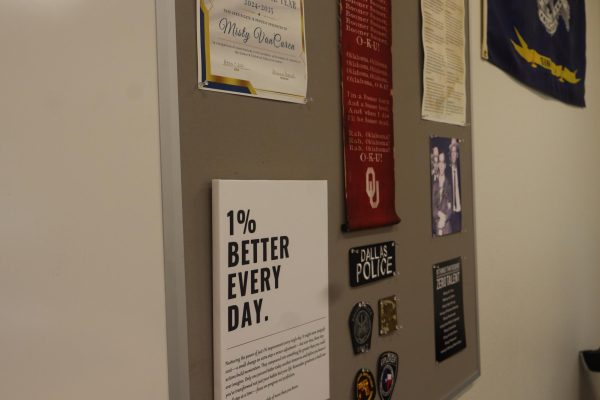
“[The law enforcement] courses cover constitutional rights, criminal court systems, and [more] hands-on elements, like making arrests and riot situations,” said Misty Vancuren, who teaches Survey of Law and Law Enforcement II. “I do a lot of scenario-based problem solving, which is [a major part] of when you take certification tests in the real world. AI helps me create unique scenarios where students have to make critical decisions based on real-world implications.”
With platforms such as Google’s NotebookLM, many teachers are adopting AI as a study tool— especially when summarizing complex information. For Project Lead The Way engineering classes, which culminate in an end-of-course exam, platforms like these offer an effective method to learn large amounts of content.
“When learning orbital mechanics, our teacher uploads the slides and notes into NotebookLM, which converts them into presentations, quizzes, and tutorials to help us understand [the material] easier,” said Independence senior and aerospace engineering student Lucas Santos. “It’s pretty useful. Instead of [attempting to] understand the information raw, you can go through the quizzes and have the examples to learn.”
Despite its academic advantages, students consider the lines between plagiarism and assistance. Many graduating seniors also examine if AI should be used in their collegiate careers.
“I use it a lot for gathering sources for research,” Heritage senior Srikar Koppana said. “[But] you can also get bad habits from [overusing] it, especially in college and in the workforce. Civil engineering matters in terms of the safety of people and infrastructure, so if you’re using AI that’s not a hundred percent accurate, it’s not safe. I definitely think it shouldn’t be in the industry yet.”
Additionally, many are investigating AI’s impact on the environment. In fact, according to researchers at the University of California- Riverside, a “single 100-word AI prompt can consume up to a 16-oz bottle of water.” For Horticulture Science teacher Lauren Dye, AI’s water intake poses an important challenge for her industry.
“There was a story of this Kansas woman who [owned] a generations-old farm, and an AI company wanted to buy it to build a data center on her property,” Dye said. “She still said ‘no,’ saying how the farm was ‘essential for everyone in America.’ It was wild to me– when we’re getting rid of farmland for these data centers, we now have issues. In the future, I think I need to start implementing these lessons in my class.”
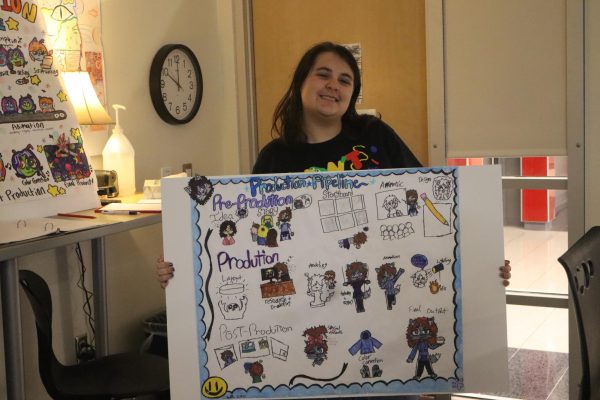
Students in creative fields, like Animation I student Satviki Devabhaktuni, question AI’s implications on artistic expression.
“AI should never be a part of art, but there are people who are still going to use it,” Devabhaktuni, a sophomore at Liberty High School, said. “I never use AI [as I design]. It seems to take all the creativity out of the process, which is something that I absolutely hate.”
Moving forward, students and teachers alike are opting for a mindset like Dye’s: one that uses AI in moderation.
“I think we’re losing ourselves in AI,” Dye said. “We have to change our curriculum as the world changes, because technology is improving— not just for crops and farming, but also for our everyday tasks. [AI] is spreading like wildfire. Is that a good thing or a bad thing? I just think it needs to be regulated.”